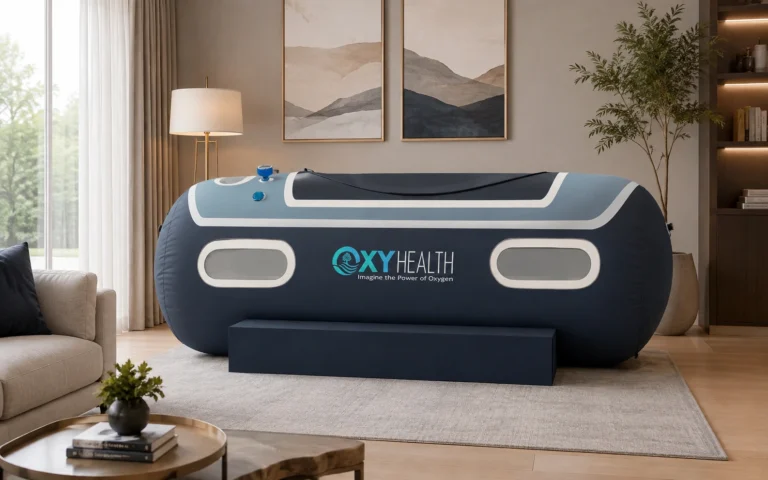
Innovative regeneration devices for professional and home use alike.


mHBOT cabin or clinical HBOT? A comparison of oxygen therapy devices
Oxygen plays a fundamental role in the functioning of the body: it is needed for energy production, for the metabolism of the cells and for the normal functioning of the tissues. mHBOT - mild hyperbaric oxygen therapy - makes use of the principle that at elevated ambient pressure more oxygen can enter the body than under normal atmospheric conditions.
The mHBOT cabins have in recent years appeared more and more often in regeneration and wellness centres, in sports clubs and even in homes. If you are considering buying a device, this article goes through what the method can do, what the difference is between mHBOT and clinical HBOT, and along which parameters it is worth comparing cabins.
It is important to be clear: mHBOT and the HBOT applied in hospital conditions are not the same procedure, and the strength of the scientific evidence relating to the two methods also differs. A 2026 literature review expressly points out that it is not correct to use the two terms as synonyms - not even in distributor communication.
What is mHBOT, and what can a mild hyperbaric cabin do?
The essence of mHBOT is that the user stays in an enclosed, pressurised chamber. Normal sea-level air pressure is about 1 ATA, that is, one atmosphere; in a mild hyperbaric environment a slightly higher pressure is applied. The terminology in the literature is not entirely uniform, but the Undersea and Hyperbaric Medical Society typically uses the term mild hyperbaric oxygen for treatments carried out at pressures below 1.5 ATA - home and wellness cabins typically work between 1.2 and 1.4 ATA.
The increase in pressure is interesting from a physical point of view because it influences how much oxygen can dissolve in the blood plasma and how much can reach the tissues. Under normal conditions the great majority of the oxygen in the blood is carried by haemoglobin; at elevated pressure, however, the amount of oxygen dissolved in the plasma may also increase. This is one of the fundamental physiological mechanisms of hyperbaric oxygen treatments - and it is why the maximum pressure of a cabin is the most important parameter on the data sheet.
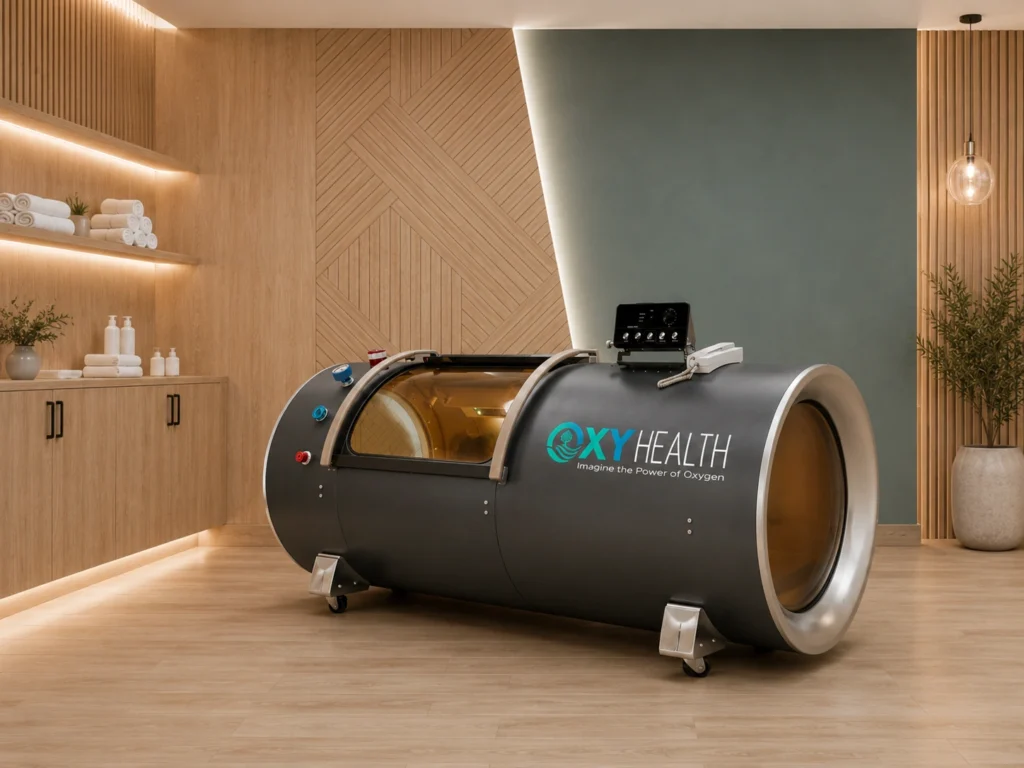
What exactly does mild hyperbaric oxygen therapy mean?
The word mild refers primarily to the lower chamber pressure and the typically lower oxygen concentration. During conventional HBOT the patient generally breathes high-concentration or 100% oxygen at higher pressure in a medical hyperbaric chamber. mHBOT works at a lower pressure, and the concentration of the oxygen breathed in may vary depending on the concentrator belonging to the system - which is why it is always worth looking at the cabin and the concentrator together, not just the cabin.
For this reason the extent of the physiological effect produced by mHBOT is not the same as that of classic HBOT. This is an important difference, because a result demonstrated with HBOT in a scientific study cannot automatically be regarded as valid for mHBOT.
How does mHBOT work?
When the pressure in the chamber gradually rises, the partial pressure of the inhaled gases also increases. As a result more oxygen can pass from the lungs into the blood, and the amount of oxygen physically dissolved in the plasma may increase. In theory this may also support the oxygen supply of tissues to which the circulation delivers oxygen with more difficulty.
In connection with hyperbaric oxygen therapy, several cell-level processes that it may affect are also being studied:
- microcirculation,
- the energy metabolism of the cells,
- inflammatory signalling processes,
- regeneration,
- and certain tissue repair mechanisms.
According to a recent review from 2026, mild hyperbaric oxygen treatment may also have an effect on peripheral microcirculation, parasympathetic activity and metabolism – at the same time, the clinical applications of mHBOT have been studied considerably less than conventional HBOT.
What are hyperbaric cabins used for?
In a regeneration and wellness setting mHBOT is used primarily to support general recovery, after sporting exertion, and to support energy levels and well-being. It is important to distinguish between purposes of use and proven medical indications - this distinction is also compulsory when selling the device and communicating about the service.
Classical HBOT has well-defined medical areas of use – for example decompression sickness, arterial gas embolism, certain cases of carbon monoxide poisoning, some slow-healing wounds and radiation injuries. In the case of mHBOT, however, many wellness and regeneration applications are still at the research stage, so it is not correct to communicate about it as if it were a proven cure for diseases.
Recovery and sport
After intensive physical exertion the body needs time to restore the muscles, the connective tissue and the energy stores, so it seems logical to assume that an increased oxygen supply may support certain regeneration processes. The results of research examining the sports and musculoskeletal applications of classic HBOT are mixed, however: according to a 2026 systematic review the results are not clear in cases of muscle damage and delayed onset muscle soreness, while more favourable results were found for certain bone and joint problems. As mHBOT works at a lower pressure, direct conclusions must not be drawn from the HBOT results either.
Energy levels, freshness and well-being
Many people choose mHBOT treatment because afterwards they feel fresher, more energetic or mentally more alert. One possible explanation for this is the combination of increased oxygen supply and circulatory changes. Improvement in subjective well-being, however, may depend on many factors - on sleep, stress, nutrition, physical activity and general state of health. If you would like to try the method before buying, this is what the oxygen therapy treatments at the Imagine Health Center is possible.
Microcirculation and tissue oxygen supply
Microcirculation means the blood flow in the smallest vessels of the body - it is through these that oxygen and nutrients reach the cells. Elevated ambient pressure and a higher oxygen level may temporarily change the oxygen supply of the tissues. According to the most recent reviews, the effect of mHBOT on microcirculation is a promising research area, but further controlled trials are needed.
How does a treatment in the cabin work?
The treatment is typically a calm, passive process. The user lies down or settles comfortably in the hyperbaric chamber, and after it is closed the system gradually increases the pressure. During the change in pressure a sensation similar to take-off or landing in an aircraft may occur in the ears - this is a natural phenomenon.
What helps with equalising the pressure?
- swallowing,
- yawning,
- chewing movements,
- or a suitable pressure equalisation technique.
Once the desired pressure has been reached, the main phase of the treatment follows, the length of which may vary depending on the equipment and the protocol - typically 60-90 minutes. At the end the pressure is gradually returned to the normal atmospheric level.
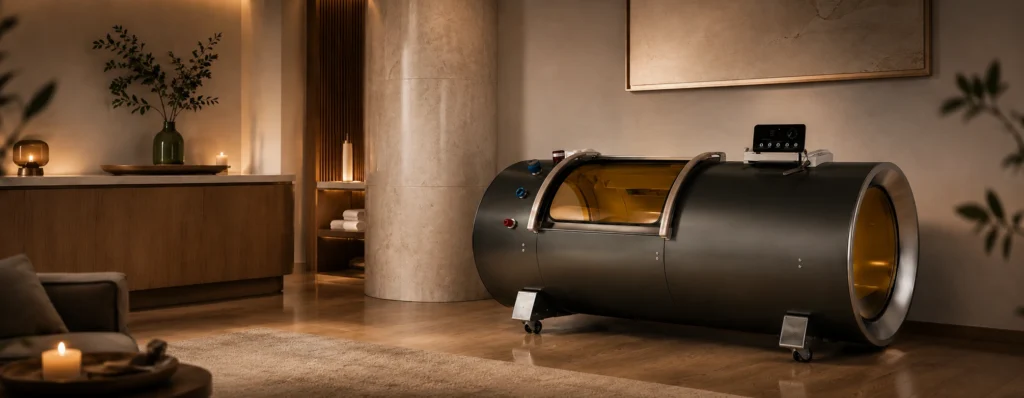
What may the user feel during the treatment?
For most people mHBOT is a calm experience. The most noticeable sensation is usually the change of pressure in the ears; some may experience warmth, relaxation or slight ear popping. If ear pain, a strong sensation of pressure, dizziness or any unusual symptom occurs, the treatment must be stopped.
HBOT and mHBOT – what is the difference?
This is one of the most important questions when choosing a cabin: it determines what you can promise the user and in what environment the equipment can be operated. The table below summarises the most important differences.
| Aspect | mHBOT | Classical HBOT |
|---|---|---|
| Meaning | Mild Hyperbaric Oxygen Therapy | Hyperbaric Oxygen Therapy |
| Pressure | Lower: typically 1.2-1.4 ATA, always below 1.5 ATA | Higher, typically 2-2.8 ATA according to medical protocol |
| Oxygen concentration | Depends on the concentrator supplied with the cabin | Almost always 100% medical oxygen |
| Environment | A sports club, wellness area, practice or the home | Healthcare institutions only, with specialist staff |
| Primary aim | Supporting recovery and well-being, a wellness service | The treatment of defined medical indications |
| Scientific background | A growing body of research, with evidence still limited in several areas | A longer clinical history, with strong evidence for a number of indications |
| Load | Lower pressure load, usable independently after training | Greater pressure and oxygen load, with continuous supervision |
| Risks | A lower load, but not risk-free - a protocol is needed | Documented side effects, strict medical protocols |
The two methods are therefore built on the same principle - elevated ambient pressure and an increased oxygen supply - but they are not the same treatment. According to the position of the Undersea and Hyperbaric Medical Society, many clinical uses of the lower, sub-1.5 ATA mild treatments cannot currently be regarded as proven. This does not mean that mHBOT has no physiological effect, but that it must not be confused with the already proven medical HBOT indications.
Who is it worth buying a hyperbaric cabin for?
For regeneration purposes, primarily those who:
- do sport regularly, or work with athletes,
- are exposed to a heavy physical or mental load,
- would like to support their recovery regularly,
- who would add a new element to their wellness or regeneration service,
- would like to use oxygen therapy at home, at their own pace.
The response may differ from person to person, and mHBOT does not replace adequate sleep, nutrition, fluid intake, exercise or, where needed, medical treatment. Many people combine it with other regeneration devices - such as with a cryotherapy chamber or with a pressure therapy device .
How many sessions are needed, and what does that mean for the utilisation of the cabin?
There is no single general answer to this. A single session can be an interesting wellness experience, while regular regeneration programmes work with courses consisting of several treatments. The optimal frequency depends on the goal, the pressure applied, the oxygen concentration, individual condition and the equipment. One of the problems with the research is precisely that mHBOT protocols vary widely. When buying equipment this question matters for planning daily capacity: with a 60-minute protocol one cabin can serve 6-8 sessions a day. The available models are OXYGEN THERAPY DEVICES page.
Are there any side effects?
Yes. Despite the lower pressure, mHBOT is not entirely risk-free either. With hyperbaric treatments one of the most common discomforts relates to equalising the pressure in the ears: with classical HBOT the most common side effects include middle ear barotrauma and an uncomfortable sensation of pressure in the ears.
At higher pressures and with longer treatment series the frequency of side effects may increase: in a meta-analysis combining 24 randomised trials, adverse events were more frequent with treatments above 2 ATA. This partly explains why mHBOT works at a lower pressure.
Who is it not recommended for?
The exact contraindications depend on the equipment and the protocol, so the manufacturer documentation is always decisive, and a prior assessment of condition is advisable in every case. It is particularly appropriate to consult a specialist or a doctor in the following cases, for example:
- significant lung disease,
- untreated pneumothorax,
- a serious ear or sinus problem,
- certain cardiovascular conditions,
- acute infection or a feverish condition,
- pregnancy,
- or when taking certain medicines.
If someone has a known chronic illness, it is definitely advisable to seek medical advice before starting mHBOT.
mHBOT and weight loss
Spectacular claims about weight loss are often attached to oxygen therapy on the internet as well. An increased oxygen supply may indeed influence certain metabolic processes, but there is currently no adequate evidence that mHBOT on its own causes significant weight loss. It is therefore not worth regarding it as a standalone method for weight loss - and as a distributor one must not advertise it that way either.
What to look out for when choosing an mHBOT cabin
It is not only a question of whether there is a hyperbaric chamber. Before buying it is worth asking about all of the following:
- What is the maximum operating pressure of the cabin (ATA)?
- Which oxygen concentrator comes with it, and what is its output?
- What are the internal dimensions, and what is getting in like - a seated or a lying cabin?
- What is the noise level, the ventilation and the space requirement?
- What guarantee, service and safety documentation come with the equipment?
This is particularly important because the technical parameters of mHBOT can differ significantly from manufacturer to manufacturer. The 2026 literature reviews also emphasise that the inconsistent use of the terms mHBOT and HBOT makes it harder to compare different treatments and research results - so it is always worth comparing the actual technical data rather than the marketing copy.

Summary: what is worth knowing about mHBOT cabins?
mHBOT is oxygen therapy at mild positive pressure, in which the body is placed in an environment at a pressure higher than normal atmospheric pressure. As a result, the amount of oxygen available in the blood and the tissues may increase, which may have an effect on several physiological processes. In a wellness and regeneration setting it is used primarily by athletes, people living an active life and those who want to support their recovery or well-being - increasingly in their own cabin at home.
The most important thing, however, is to understand that mHBOT is not the same as medical HBOT. Classic HBOT applies higher pressure and typically a higher oxygen concentration and is a proven medical treatment for several well-defined conditions. With mHBOT a number of promising physiological and regenerative effects are being studied, but the scientific evidence is still limited in several areas. It is therefore sensible to regard it as a modern regeneration device that, under the right conditions, may be a useful part of a comprehensive lifestyle and recovery programme, but does not replace medical diagnosis or treatment.
Take a look at the oxygen therapy devices
Request a quotation for the mHBOT cabins, or find out about the rental options.