Innovative regeneration devices for professional and home use alike.


AI massage machine and precision robot massage: what it can do and what to look for when buying
Massage technology has developed strikingly in the last few years. Alongside classic vibration massagers and massage guns, robotic massage systems supported by artificial intelligence can now be bought as well - systems that map the body, apply precise pressure to defined areas and repeat a set programme from session to session with great accuracy.
We can call this precision massage: the treatment does not depend on the hand strength and tiredness of a person at a given moment; instead the pressure, the speed, the path of movement, the treatment time and the attention given to each body area can all be controlled mechanically. From an operator point of view this predictability is the greatest value.
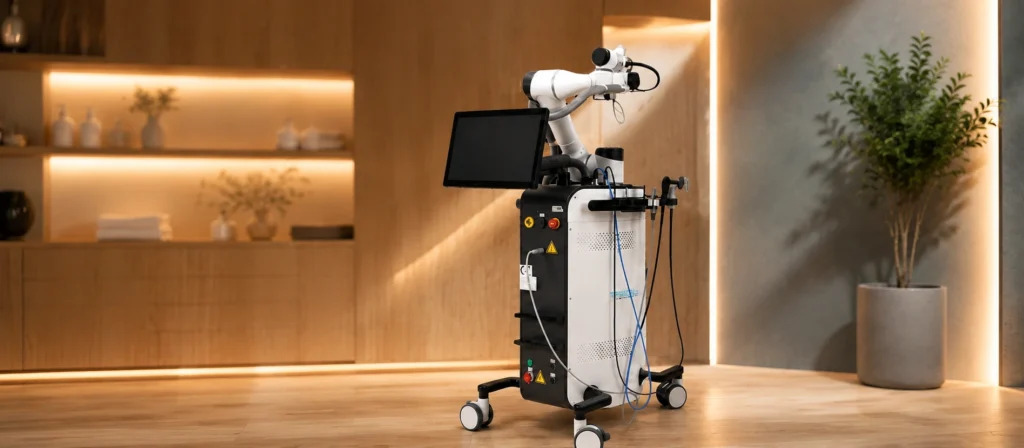
Robot massage, however, is not simply an automatic massage chair in a new guise. The more advanced systems use robot arms, sensors, motion control, digital body mapping and, increasingly, artificial intelligence. In our range this direction is represented by the VITALPRESS HEALTH AI Robotic-M represents.
The technology is still relatively young. Scientific studies of robot-assisted massage are already available: a systematic review identified 17 studies examining back, shoulder, scalp, whole-body and rehabilitation robot massage. The results are promising, but most of the research is still small-scale and preliminary in nature - this is worth weighing realistically before buying a device.
What does AI massage mean on the data sheet of a device?
The term AI massage is used quite broadly today, so it is always worth reading the technical description rather than the marketing copy. Not every robot massage is genuinely controlled by artificial intelligence. Some systems simply carry out predefined sequences of movement, others correct the position of the robot arm on the basis of sensor data, while the more advanced systems create a digital body map, recognise the anatomical contours of the body and adjust the path of the treatment accordingly.
The VITALPRESS HEALTH AI Robotic-M belongs to this new generation: according to the manufacturer documentation it is a robot massage system controlled by artificial intelligence whose main advantage is precise, stable and reproducible treatment.
The most important characteristic of robot massage is therefore not the word AI itself but controllability and repeatability. If the machine carries out a programme today for 20 minutes with the same pressure and path, it can deliver a very similar treatment next time as well - commercially, this is what makes a service possible to standardise.
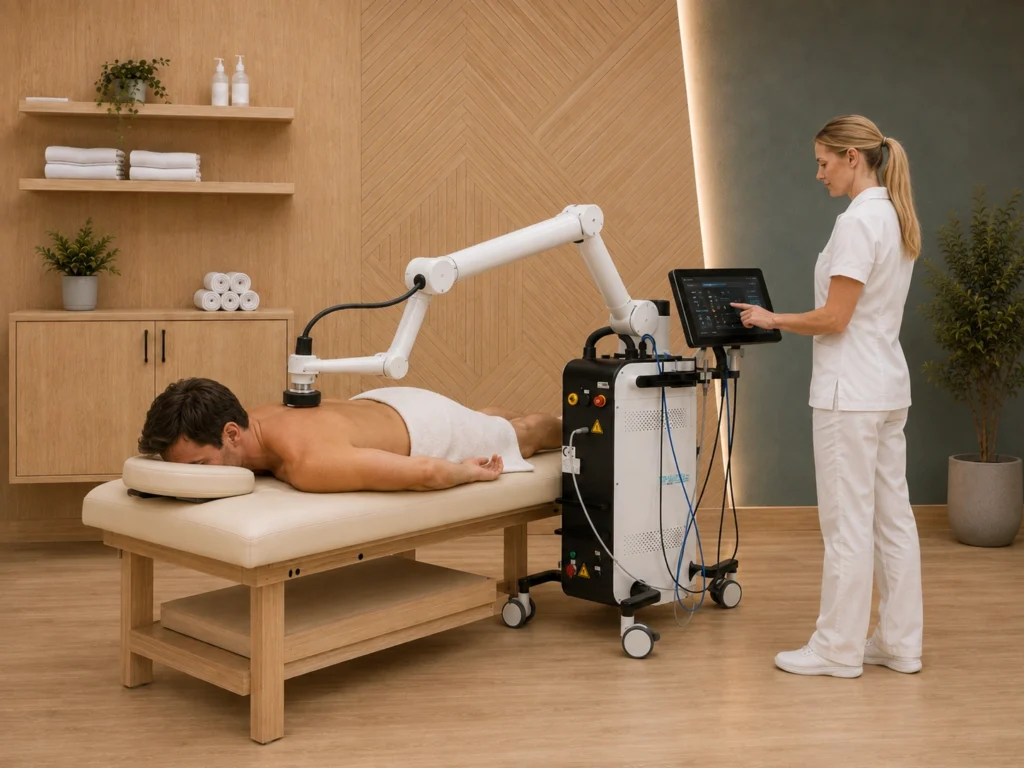
How is a modern massage robot built?
The exact technology differs from device to device, but an advanced robot massage system consists of several main components.
Robotic arm
The most striking element is the robot arm itself. The arm, with several joints, moves in three-dimensional space, similarly to industrial or medical robots. The massage head is fitted to the end of the arm, and its shape and material determine how it comes into contact with the body. The system may thus be able to:
- long gliding strokes
- circular massage
- targeted pressure
- repeated kneading-type movements
- treating specific muscle groups
Sensors and force control
A robot arm on its own is not enough. One key to precision massage is that the device senses the force with which it is in contact with the body. This is what the following are for:
- force sensors
- torque sensors
- position sensors
- distance sensors
- cameras or other imaging systems
This feedback is what allows the robot to move not along a fixed path but to respond to the shape of the body and the contact. In rehabilitation robotics this is precisely one of the most important directions of development: feedback based on sensor data makes the control of load more precise. When choosing a device, the presence of force sensing is therefore a basic requirement.
Digital body map
The more modern systems first map the body surface to be treated - with a camera, 3D sensing, given body parameters or through the movement of the robot arm itself. The aim is for the system to be able to determine where the shoulder is, where the spine runs, where the shoulder blade begins, how wide the back is and how tall the user is.
This matters because the build of two people is never entirely identical. A genuinely advanced precision system therefore does not perform the same movement at the same coordinate; it adapts the path of the treatment to the body of the user.
Where does artificial intelligence come in?
Artificial intelligence can be connected to robotic massage in several ways:
- Body recognition - the system identifies the contours of the body and the regions that can be treated.
- Motion planning - an algorithm selects the path along which the robot arm should move.
- Pressure control - the system adjusts the pressure on the basis of the sensor data.
- Personalisation - the settings of earlier treatments can be saved, so the same programme can be started next time.
- Safety - the sensors and the software recognise when the user moves or when the robot meets unexpected resistance.
It is important, however, that AI in itself is not a guarantee of quality. The value of a device is determined more by how accurate its sensors are, how finely the pressure can be controlled, how well the body mapping works and what safety systems it has.
What does precision massage mean?
The term precision massage describes one of the greatest advantages of robotic massage well. A human masseur senses a great deal of fine information with their hands, but treatment given by hand necessarily varies. The robot, by contrast, reproduces the same pressure, speed, path, number of repetitions and treatment time very precisely.
This matters particularly when it is not a one-off relaxation experience but a treatment protocol that can be standardised - in the range of a sports club or studio, for example. In other areas of robot-assisted rehabilitation, precise, repeatable movement that can be carried out in large volumes is likewise one of the main technological advantages.
Which body parts can be treated?
This depends greatly on the design of the particular robot. Research has already examined robot massage on the lower back, the back, the shoulder, the neck, the scalp, the face, the lower limbs and in whole-body systems.
In practice most robots work particularly well on the larger, easily accessible muscle groups:
- back
- lower back
- shoulder
- glutes
- thigh
- calf
Some systems have more limited access to the front of the neck, the hand or the fine areas of the face - if these are needed too, it is worth looking separately at the range of treatment heads.
How does it differ from a massage chair or a massage gun?
In a classic massage chair the rollers move along a track built into the backrest. Modern robot massage, by contrast, uses a more freely moving robot arm, which gives far more freedom of movement: it can approach the body at different angles, change the direction of pressure, treat an area in a more targeted way and adapt better to the shape of the body. This brings the technology closer to the movement vocabulary of manual massage - and it is one reason why it is in a different price category.
A massage gun, by contrast, applies percussion therapy: it stimulates the muscles with rapid, repeated striking movements. This is a completely different mechanic from the longer pressing, gliding or kneading movements of a robot arm. The massage gun is small, mobile, cheaper and easy to use; its disadvantage is that someone has to hold it throughout and the strength of the pressure depends on the person using it. A robot massage, by contrast, carries out a longer programme on its own.
Robotic massage or traditional manual massage?
They are not necessarily competitors. Manual massage has a quality that robotics can still reproduce only with difficulty: human touch and continuous, intuitive adaptation. An experienced masseur senses changes in muscle tension, the reactions of the guest, small anatomical differences and the tone of the tissues.
| Aspect | Robotic massage | Manual massage |
|---|---|---|
| Pressure | Digitally adjustable and stays the same to the end of the programme | Depends on the hand, the strength and the daily form of the masseur |
| Repeatability | The same from session to session, according to the programme | Naturally varies from session to session |
| Adaptation | On the basis of sensor data and a digital body map | Continuous tactile feedback, instinctive correction |
| Strong point | Large muscle groups, longer, repeatable programmes | Fine areas and complex manual techniques |
| Experience | A technological experience, without human touch | A personal experience, with direct communication |
In a randomised crossover study 21 participants received both manual and robot massage. Certain stress-related physiological measures decreased after both treatments, although manual massage showed a stronger effect in some relaxation variables. In practice, then, we are talking about two different experiences that sit well side by side in a range of services.
One practical advantage of robot massage is constant pressure: over a longer working day even the muscles of an experienced masseur tire. A machine has no such physiological fatigue, so at the end of the treatment it works with the same set pressure as at the beginning - this matters for planning daily capacity too.
Can the treatment be personalised?
One essential element of modern robot massage is precisely how far it can be personalised. Depending on the system, the following can be set:
- the body area to be treated
- the intensity
- the treatment time
- the massage style
- the time spent on individual areas
- the regions to be skipped
A further advantage of digital control is that user preferences can be saved. One guest can ask for a stronger lower back and back treatment while another prefers a gentler programme concentrating on the shoulder and shoulder blade area - as a service provider this is a considerable advantage with returning guests.
What is it used for in practice?
In a wellness and regeneration setting, the most common purposes of robotic massage are the following.
Releasing muscle tension
After long periods of sitting, physical work or training, tension in the muscles of the back, shoulders and lower back is common. Mechanical massage can help to relax the muscles and improve the feeling of comfort.
Post-sport regeneration
For athletes, an interesting area of use for robot massage is the targeted treatment of large muscle groups: thigh, glutes, lower back, back and shoulder. In a practical test a commercial AI robot massage system proved distinctly effective on the large muscle groups, while it was less able to reproduce the movements of a human practitioner in finer areas.
Relaxation
Massage is not only about the muscles. Regular, rhythmic mechanical stimulation can also produce a relaxing effect. Studies examining robotic massage have also measured psychological and physiological relaxation indicators, and several studies reported favourable changes.
Sedentary work
One of the most obvious target groups is people who spend several hours a day in front of a computer. Frequently affected areas are the neck and shoulder girdle, the area around the shoulder blades, the back and the lower back. In this case robot massage can be understood primarily as a comfort and wellness treatment - a frequent element of office wellness programmes.
Who is it worth buying an AI massage machine for?
Primarily for those users and service providers whose guests or family members:
- sit a lot
- do sport regularly
- often feel muscle tension
- like firm massage
- want a predictable intensity that is always the same
- do not necessarily need the human contact associated with traditional massage
- are looking for a modern, technological wellness experience
As a service provider, a further argument is that the machine works even when no masseur is free - so opening hours can be used more fully. It is also an interesting alternative for those who feel uncomfortable during a traditional massage at being touched by another person: with a robot this social factor essentially disappears.
How does a treatment take place?
The exact process depends on the device, but generally the treatment programme is selected first. The user then settles into an appropriate position on the treatment bed. The system determines or maps the body surface to be treated, then the robot arm starts the programme and the treatment head moves along a defined path.
During the treatment the user or the operator - depending on the type of system - can change the pressure, the treatment time and the area covered, and can also stop the treatment. The latter is a particularly important safety function and a basic requirement with every serious device.
There is no single standard strength: the advantage of modern systems is precisely that the pressure can be controlled. The aim is not the strongest possible treatment, because excessive pressure may cause pain and tissue irritation. A good massage can be strong, but it does not have to hurt to feel effective.
What other massage technologies are there in the range?
The robot arm is only one direction in the development of massage technology - it is worth knowing the others too.
- Percussion massage - this includes the MASSAGE GUNSwhich stimulate the muscles with rapid mechanical impulses. A cheap, mobile way into the category.
- Pneumatic compression - compression boots and cuffs work with air chambers and rhythmic pressure. This serves primarily to support circulation and fluid movement, so it uses a different mechanism from robot massage. There is more about this in the pressure therapy devices you can read about it.
- Vibration systems - they stimulate the tissues with vibration at different frequencies.
- Massage combined with heat - some devices combine mechanical massage with heating; heat on its own also influences comfort and surface circulation.
- Sensor-controlled robot massage - with the help of sensors the robot continuously monitors its position, the contact force, the surface of the body and, in certain systems, the reactions of the user.
The next step in development may be when the system does not merely carry out the selected treatment but learns from the data of several treatments. In theory a digital profile could then be built up of the intensity a given user prefers, which areas they have treated more often and which programme they choose. According to research into the use of AI and robotics in rehabilitation, real-time assessment and personalisation are indeed one of the most important directions of development.
Is robotic massage safe?
Safety depends greatly on the particular device - which is why it is worth going through the manufacturer documentation before buying. A modern system should have several protective functions:
- force limitation
- movement limits
- collision detection
- emergency stop
- monitoring of body position
Overall, the systematic review dealing with robotic massage found promising safety and usability results, while emphasising that the number and quality of the available studies is still limited.
Who is it not recommended for?
Robot massage is not appropriate in every case. It is particularly advisable to consult a doctor or a specialist in the following cases - as an operator it is worth building this list into the pre-treatment questionnaire as well:
- acute injury
- recent surgery
- bone fracture
- severe pain or pain of unknown origin
- acute inflammation
- significant osteoporosis
- blood clotting problems
- suspected thrombosis
- impaired sensation
- severe skin condition
- feverish condition
During pregnancy it is likewise worth asking a healthcare professional's opinion beforehand, especially before treatment of the lower back, abdomen and pelvic area.
An AI system recognises the shape of the body, the position and certain technical parameters, but this does not mean that it could diagnose the cause of a pain. Shoulder pain, for example, may arise from muscle tension, a joint problem, a nerve origin or another cause - a massage robot intended for wellness cannot replace a medical diagnosis, and it must not be advertised or used as such.
What to look out for when choosing an AI massage robot
A striking robot arm on its own does not say much. Before buying it is better to ask about all of the following:
- how it maps the body
- whether it has force sensing
- how precisely the intensity can be regulated
- how many treatment areas can be selected
- what treatment heads it works with
- whether it can personalise and save programmes
- whether it has a rapid emergency stop
- how it responds to the movement of the user
- how simple the interface is and what the service support is like
In a professional setting there is also the question of how consistently the device can deliver quality over successive treatments and how fully it can be used in a day.
Will it replace masseurs?
It is more likely that the two services will continue side by side. The advantages of the robot are availability, predictable treatment, precision, repeatability, tirelessness and digital settings that can be changed quickly. The advantages of a human masseur are tactile feedback, intuitive adaptation, conversation, complex manual techniques and the personal experience.
On the current state of the research it is not justified to say that robotic massage is generally better than manual massage. The available comparative studies suggest rather that each has its own advantages - in a studio the two complement each other well.
Summary: is an AI massage machine worth it?
AI-based robot massage is one of the newest technological directions in wellness and regeneration. Modern systems combine a robot arm, digital control, sensors and, increasingly, artificial intelligence so that the massage can be controlled, reproduced and personalised more precisely. It is worth considering mainly for treating the back, the lower back, the shoulders, the larger muscle groups and areas loaded after sport.
The advantage of the technology over manual massage is not that it massages better, but that it carries out the set parameters extremely consistently. The scientific background is developing: on the basis of current systematic reviews, robot massage may be promising in supporting relaxation, well-being and certain physical functions, although the evidence is still far smaller than for traditional massage.
For this very reason an AI robot massage machine should currently be regarded as an innovative wellness and regeneration device: a precise, programmable and personalisable solution for those looking for a technology-based alternative alongside or instead of classic massage - whether for the home or to expand a range of services.
Take a look at the AI massage machine
Request a quotation for the VITALPRESS HEALTH AI Robotic-M robot massage, or find out about rental.